

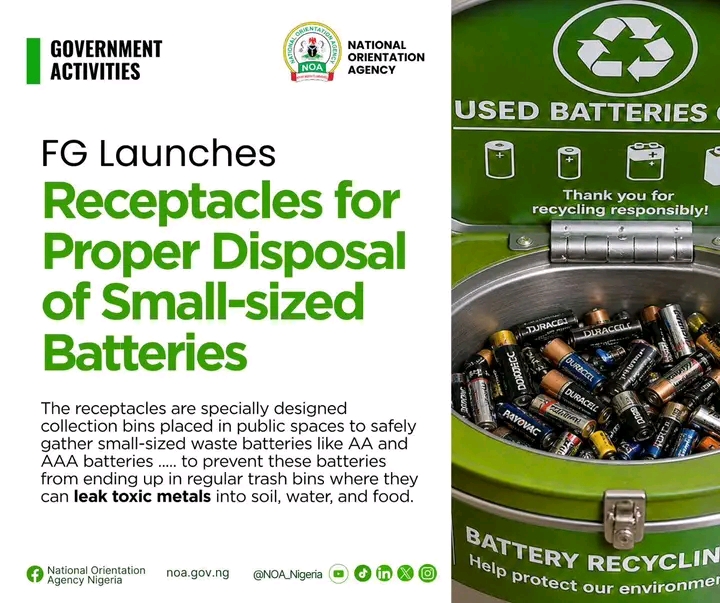
The Federal Government has introduced special collection bins for the safe disposal of small-sized batteries, in a fresh push to curb pollution linked to toxic waste.
The development was disclosed in a press release issued by the National Orientation Agency, detailing a nationwide plan led by the Federal Ministry of Environment to address the dangers posed by discarded batteries.

The initiative, unveiled by Environment Minister Balarabe Abbas Lawal, centres on the placement of designated receptacles in public locations for the collection of used batteries. These include common household types such as AA and AAA batteries, button cells used in wristwatches and calculators, as well as those found in mobile phones and medical devices.
Officials explained that the move is aimed at stopping harmful substances from seeping into the environment when such items are dumped alongside general waste. Small batteries, often overlooked due to their limited resale value, have continued to pose environmental risks through informal disposal practices.
The programme introduces a central system for gathering, storing and recycling used batteries, with the Federal Capital Territory set to serve as the pilot phase. Markets, schools, offices and other public areas are expected to host the collection points before a wider rollout across the country.
Authorities said the effort is being carried out in collaboration with the Alliance for Responsible Battery Recycling as part of steps to enforce Nigeria’s 2022 policy on waste and battery management. The move also reflects growing global concern over lead exposure, a subject of recent discussions at international forums including the United Nations.
Regulatory bodies are expected to intensify monitoring to ensure compliance, while the ministry is pushing for tougher laws to strengthen environmental protection standards.
Speaking on the need for stricter enforcement, the minister said, “We cannot continue to rely on policies without enforcement. There must be laws with real consequences to change behaviour.”
For advertising, promotions, news coverage, birthday wishes and situation reports, contact us at nationalparrotnews@gmail.com .