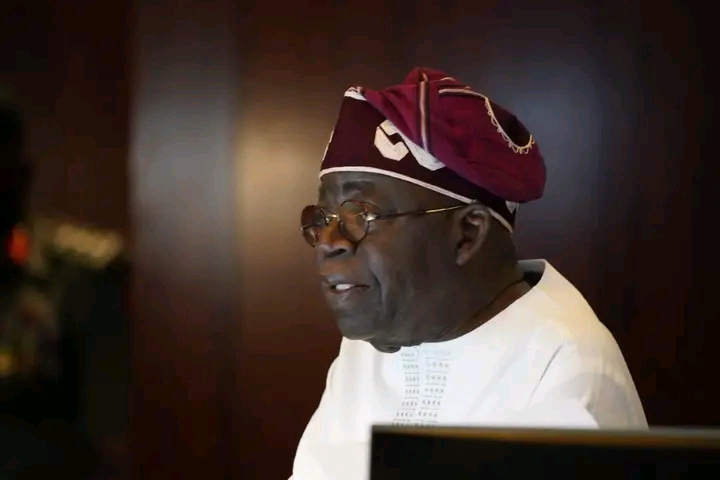
President Bola Tinubu has commended corporate players, investors and other stakeholders in Nigeria’s capital market following the Nigerian Exchange’s climb beyond the N100 trillion market capitalisation mark, describing the feat as a major boost for investor confidence.

The President’s remarks were contained in a statement issued on Thursday by his Special Adviser on Information and Strategy, Mr Bayo Onanuga, at the State House.
Tinubu said the achievement marked a turning point for the economy and should encourage Nigerians to channel more funds into local enterprises, expressing confidence that stronger returns await investors in 2026 as ongoing reforms take firmer root.
“With the Nigerian Exchange (NGX) crossing the historic N100 trillion market capitalisation mark, the country is witnessing the birth of a new economic reality and rejuvenation,” the President said.
He noted that while several global markets struggled in 2025, Nigeria’s stock market recorded a strong rally, closing the year with a 51.19 per cent return, higher than the 37.65 per cent posted in 2024. He added that the NGX performance ranked among the best globally and had outperformed major indices such as the S&P 500 and FTSE 100, as well as several emerging markets.
“Nigeria is no longer a frontier market to be ignored—it is now a compelling destination where value is being discovered,” Tinubu stated, linking the stock market’s rise to growing confidence in the broader economy.
The President said listed companies across sectors had posted strong results, citing industrial firms that have localised supply chains and a banking sector that has shown resilience and technological innovation.
He also pointed to a growing pipeline of new listings, including indigenous energy firms, technology companies, telecoms operators and infrastructure-focused entities, saying their entry into the market would expand capitalisation and widen public ownership of the economy.
Tinubu said the gains in the capital market were complemented by improving economic indicators, noting a steady slowdown in inflation after initial challenges linked to reforms. He said monetary tightening, the end of “Ways and Means” financing and increased investment in agriculture had helped stabilise the naira and ease price pressures.
From a 24-month peak of 34.8 per cent in December 2024, the President said inflation had fallen to 14.45 per cent by November 2025, with projections of 12 per cent in 2026.
“Indeed, inflation is likely to fall below 10 per cent before the end of this year, leading to improved living standards and accelerated GDP growth,” he said, describing 2026 as a defining year for shared prosperity.
On external balances, Tinubu said Nigeria recorded a current account surplus of $16 billion in 2024, with the Central Bank of Nigeria projecting a rise to $18.81 billion in 2026, from $16.94 billion in 2025.
He added that non-oil exports rose by 48 per cent by the third quarter of 2025 to N9.2 trillion, while exports to Africa jumped by 97 per cent to N4.9 trillion. Manufacturing exports, he said, increased by 67 per cent year-on-year in the second quarter of 2025.
The President said foreign reserves had crossed $45 billion, strengthening the Central Bank’s capacity to maintain stability, with projections that reserves would exceed $50 billion in the first quarter of 2026.
He also highlighted progress in rail expansion, major highways, ports, healthcare delivery, education funding through the Nigeria Education Loan Fund and increased research grants for universities.
“Nation-building is a process, not a destination,” Tinubu said, describing the N100 trillion market capitalisation as a clear signal of the economy’s strength and productivity.
“As your leader, I pledge to continue working unrelentingly to build an egalitarian, transparent, and high-growth economy that will be further catalysed by the historic tax and fiscal reforms that came into full implementation from January 1.”