

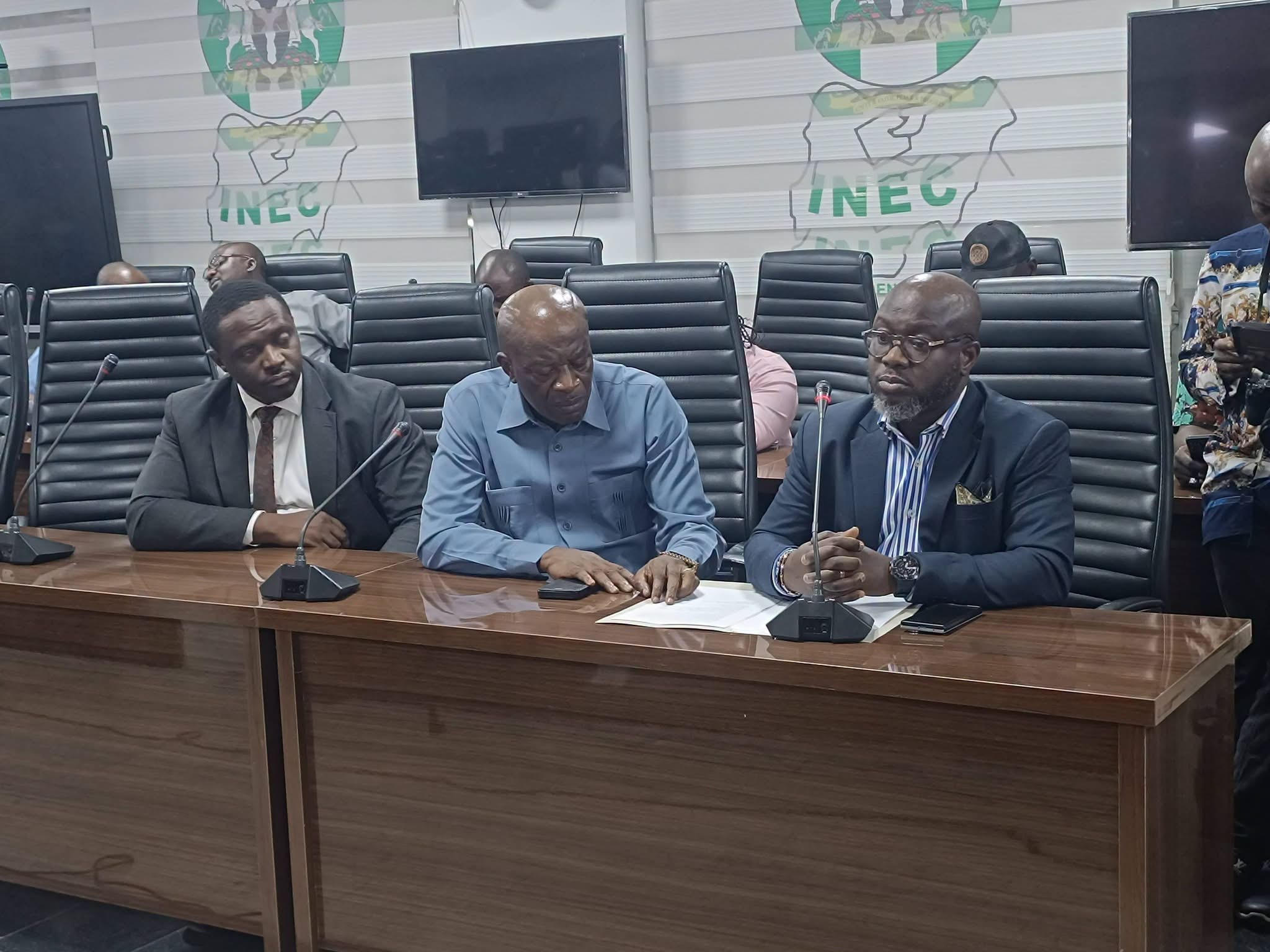
The Independent National Electoral Commission (INEC) has removed more than 1.6 million invalid voter registration records and identified 54 staff members across 10 states for alleged complicity in registration irregularities.
INEC Chairman, Professor Joash Amupitan, disclosed this on Monday, November 9, 2026, during a press conference at the Commission’s headquarters in Abuja, where he also announced fresh measures to protect the integrity of the voters’ register ahead of the 2027 general elections.

Amupitan said the Commission removed 1,608,660 confirmed invalid registrations and 873 records belonging to deceased persons following a comprehensive review of the 2025/2026 Continuous Voter Registration (CVR) exercise.
According to him, the Commission initially harvested 11,088,238 registration records across three phases of the exercise, with its Automated Biometric Identification System (ABIS) flagging 1,545,052 entries for further examination.
He explained that being flagged did not automatically make a registration invalid, stressing that every suspicious entry was subjected to proper verification and adjudication.

“A flagged record is not necessarily an invalid registration: automated screening identifies matters requiring review, while authorised adjudication determines the outcome,” he said.
The INEC chairman disclosed that 1,277,052 registrations had been declared invalid before the publication of the Preliminary Register of Voters.
Following complaints, claims and objections received during the statutory display period, another 268,000 cases were subjected to adjudication. Of these, 217,722 were invalidated, while 50,278 were cleared and retained in the register.
A further screening exercise identified 113,886 invalid entries, bringing the total post-display removals to 331,608.
Amupitan said investigations into the irregularities uncovered deliberate attempts by some registration personnel to circumvent established procedures, including the misuse of provisions designed to accommodate exceptional registration circumstances.
“The Commission found instances in which certain registration personnel deliberately circumvented established registration procedures and misused provisions intended for exceptional registration circumstances including for persons with disabilities,” he said.
He confirmed that 54 individuals across 10 states had been identified and would face administrative disciplinary measures, including possible prosecution.
To prevent a recurrence, the Commission is strengthening its registration procedures through improved biometric capture, authentication and verification systems.
The chairman also announced a ban on web cameras for voter registration, directing the Commission’s Director of Information and Communication Technology to replace them with an application-based camera system.
He explained that the new arrangement would prevent registration officers from importing photographs from external sources through web links.
“We have just directed the director of ICT now that our IVFs, this web camera, should not be allowed again. Instead, we should have an app camera. It is what is on the app that will take picture,” he said.
The Commission also approved a comprehensive Artificial Intelligence (AI) governance framework to regulate the responsible deployment of the technology in its operations.
Amupitan said the framework was developed in collaboration with the International Foundation for Electoral Systems (IFES) and the British High Commission before undergoing peer review.
He explained that although INEC had an existing AI policy approved in 2025, developments in artificial intelligence necessitated a more comprehensive regulatory framework.
“We decided as a commission to have a comprehensive, well-laid out AI governance framework that will govern responsible deployment of AI,” he said.
The chairman further revealed that the Commission had traced access points associated with the use of AI-generated photographs to compromise the voters’ register.
He said some registration irregularities were facilitated through authorised access, warning that a compromised password could provide an opportunity for unauthorised activities.
On concerns surrounding alleged duplicate registrations and manipulated photographs circulating on social media, Amupitan clarified that many of the reported cases originated from previous registration exercises conducted between 2011 and 2023.
He warned that cleaning up the 2025/2026 registration records alone would not eliminate historical irregularities in the national register.
“The current register evolved through successive registration and CVR exercises since 2011, using different technologies, operational arrangements and quality standards,” he explained.
INEC, he said, had resolved to begin addressing questionable entries in the older register through proper verification, including cases already brought to its attention through public complaints.
The chairman also explained that some voters complaining about missing names had registered afresh instead of transferring their existing registrations to new locations.
He said the biometric system invalidated their subsequent registrations, while their original records remained at their previous polling locations.
On the planned nationwide voter revalidation exercise, Amupitan recalled that INEC had postponed the initiative following concerns from stakeholders about its proximity to the 2027 general elections.
He maintained that the postponement did not prevent the Commission from deploying existing mechanisms to protect the voters’ register.
Meanwhile, the chairman said INEC was yet to receive the judgment concerning the leadership dispute involving the African Democratic Congress (ADC), warning that the Commission would not act on reports circulating on social media.
“We don’t just act on the basis of what is on the social media,” he said.
Amupitan explained that the Commission would first obtain and study the judgment before seeking professional advice from the relevant departments and determining its next line of action.
He recalled an earlier incident involving a purported Supreme Court judgment circulated online, which the apex court later disowned.
On the distribution of Permanent Voter Cards (PVCs), the INEC chairman said distribution of cards from the first and second phases, alongside transferred PVCs, was ongoing across local government areas nationwide.
He added that some cards from the third and final phase were being delivered and would be dispatched to states by the following week.
According to him, distribution would return to Registration Areas from December 1, 2026, while appealing to affected registrants to exercise patience.
Amupitan also assured Nigerians that the Commission’s election-day procedures and deployment of the Bimodal Voter Accreditation System (BVAS) would prevent multiple voting.
He said every voter must be physically present at their designated polling unit and undergo biometric authentication through fingerprint or facial recognition before voting.
The chairman further disclosed that INEC had reviewed its information technology infrastructure and cybersecurity arrangements as part of preparations for the 2027 elections.
Describing the recent registration irregularities as an early warning, he said the Commission was taking additional measures to protect the electoral process.
On calls for early voting for journalists, electoral officials and other personnel assigned election duties, Amupitan said INEC had previously proposed the arrangement during the amendment of the Electoral Act, but the proposal did not receive the backing of the National Assembly.
He maintained that the Commission would continue advocating for the introduction of early voting to enable election duty personnel to exercise their franchise.
The chairman reaffirmed INEC’s commitment to removing invalid entries while ensuring eligible Nigerians were not wrongly excluded from the voters’ register.
The Final Register of Voters is scheduled for publication on December 15, 2026, following the completion of reconciliation, quality assurance and other publication procedures.
For advertising, promotions, news coverage, birthday wishes and situation reports, contact us at nationalparrotnews@gmail.com .