
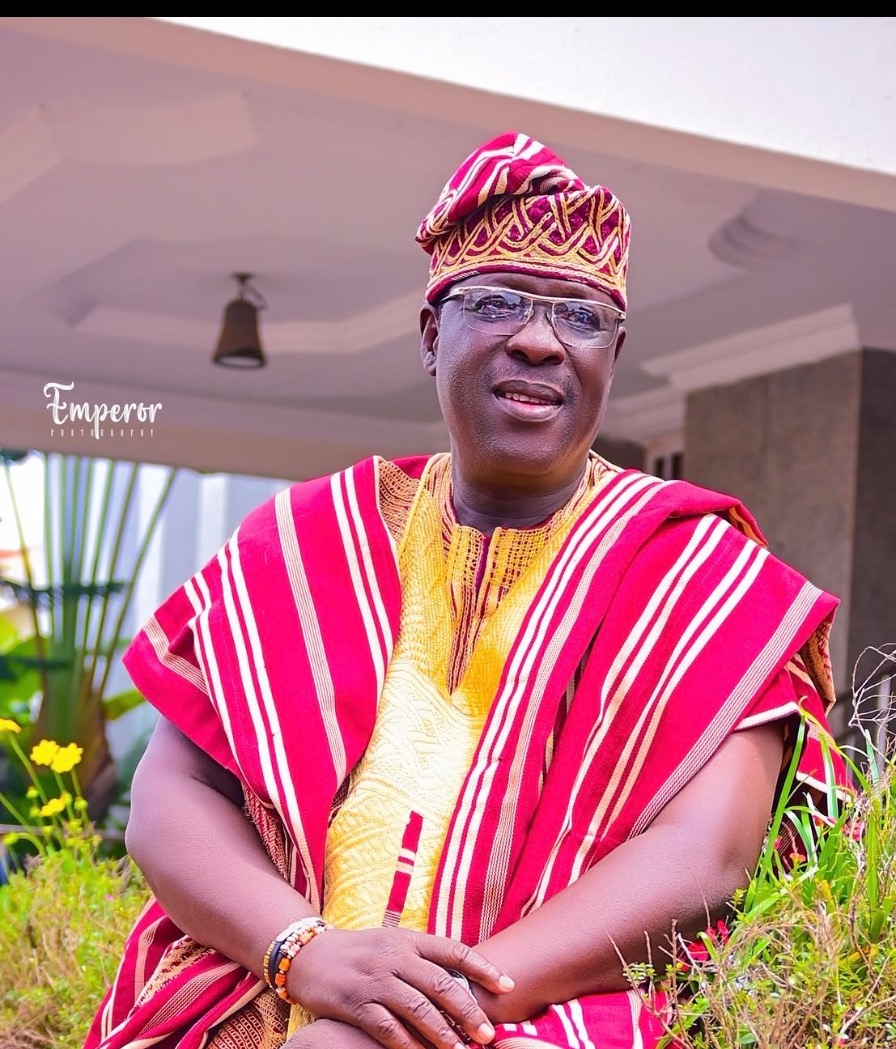
There was a time when Taiwo Hassan was not Ogogo.
Before the name became familiar to generations of Yoruba film lovers, before his commanding voice and imposing presence became part of Nigerian popular culture, he was a young man from Ilaro, Ogun State, trying to find his place in life.

Born on October 31, 1959, Hassan did not begin his journey with the privileges that often accompany the making of a star. He attended school in Ilaro before moving to Lagos, where financial difficulties interrupted his secondary education. He later trained as an automobile mechanic and worked with the Lagos State Water Corporation.
For about 13 years, he worked with the Water Corporation. Acting, meanwhile, was taking shape on the other side.
Hassan had begun performing in the early 1980s while still working. His training under theatre practitioner Awo Ademola Fagbemi gave structure to an interest that would eventually become his life’s work. In 1994, after years of combining employment with performance, he left his government job and committed himself fully to entertainment.
That decision changed everything.
But the making of Ogogo was not a sudden rise from obscurity to fame. It was a gradual passage through the demanding world of Yoruba theatre, where performers learnt their craft before audiences in an era when reputation was built on the stage and sustained by discipline.
It was also a journey shared with some of the figures who would later become pillars of Yoruba entertainment.
Hassan became associated with the Odunfa Caucus, a theatre tradition that produced and influenced several notable Yoruba actors. His relationship with Yinka Quadri became particularly significant, both professionally and personally. In an earlier interview, Hassan spoke warmly about Quadri and the bond they shared.
Hassan’s career stretched across acting, producing, directing and screenwriting, while his performances established a distinctive identity that audiences could recognise almost immediately. Over more than four decades, he survived the industry’s transition from traditional theatre to home-video production and now the modern Nollywood era. And somewhere along that journey, Taiwo Hassan became Ogogo.
For many viewers, Ogogo represented authority. Sometimes he was a traditional ruler; at other times, a feared antagonist, father, elder or troubled man caught in a conflict. His physical presence, voice and command of Yoruba performance made even supporting appearances memorable.
Yet perhaps the most important part of his story was happening away from the camera: he was becoming a teacher.
Actress Toyosi Adesanya, who trained under him through the Odunfa Caucus, recently recalled the role he played in shaping her career. She said she began her training under Ogogo in 1994 and described the influence he had on her development as an actress.
On August 23, 2026, Taiwo Hassan died at 66. His daughter, Kira Taiwo, confirmed his death during an emotional live broadcast, marking the end of a career that had lasted more than four decades.
The tributes that followed were therefore not only for an actor; they were for a theatre man, a filmmaker, a mentor, a custodian of a particular Yoruba storytelling tradition and, for millions who grew up watching him, simply Ogogo.
For advertising, promotions, news coverage, birthday wishes and situation reports, contact us at nationalparrotnews@gmail.com .