

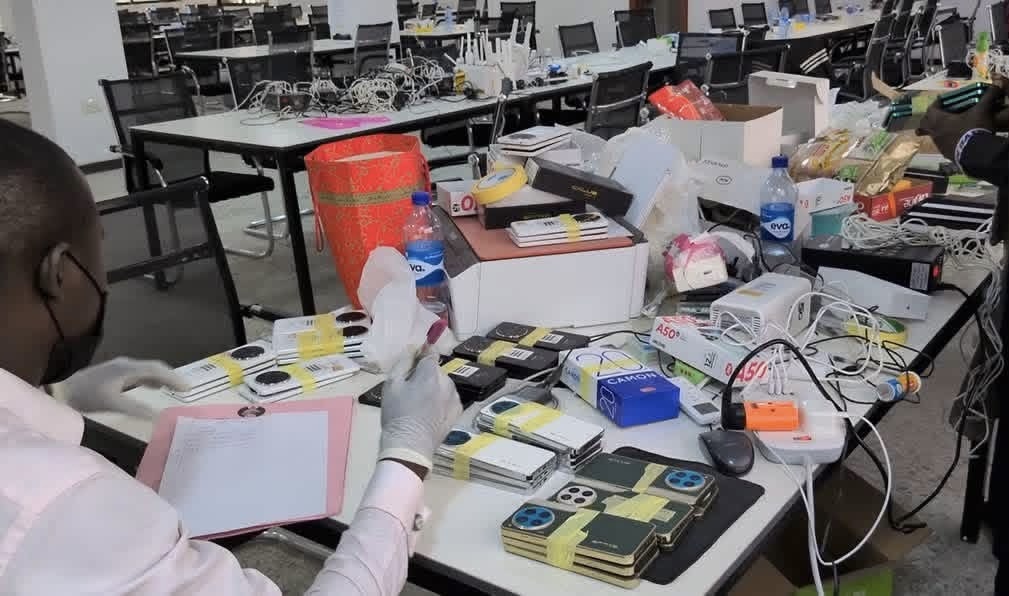
The Economic and Financial Crimes Commission, EFCC, has secured the final forfeiture of 431 mobile phones linked to convicted Chinese cyber-fraud operators in Lagos.
Justice Dehinde Dipeolu of the Federal High Court sitting in Lagos granted the forfeiture order on Tuesday, September 29, 2026, following an application filed by the EFCC.

The devices were recovered in connection with a cyber-fraud operation allegedly run from a facility known as “HK” in Victoria Island, Lagos, where Nigerian youths and foreign nationals were reportedly trained to perpetrate romance, investment and cryptocurrency fraud.
The Commission’s counsel, Hannatu Kofarnaisa, told the court that an interim forfeiture order had earlier been granted on July 8, 2026, directing the EFCC to publish a notice in a national newspaper to allow interested persons or entities to challenge the proposed forfeiture.
Kofarnaisa said the directive was complied with through publication in The Guardian newspaper on August 11, 2026, but no person or entity came forward to contest the forfeiture within the period stipulated by the court.
An affidavit filed in support of the application by an EFCC operative, Christopher Augustine, detailed the findings of the Commission’s investigation into the operation.
According to the affidavit, the operation targeted victims in the United States, Canada, Mexico and parts of Europe.
It stated that an EFCC sting operation conducted on December 10, 2024, resulted in the arrest of more than 700 people, including about 500 Nigerians, 148 Chinese, 40 Filipinos and other foreign nationals.
The affidavit identified Genting International Company Limited (GICL), allegedly controlled by Huang Haoyu, also known as Ken, and other foreign nationals as being involved in the operation.
Huang and GICL were subsequently charged with seven counts relating to cyber terrorism, possession of fraudulent documents, failure to declare activities to the Special Control Unit Against Money Laundering, SCUML, illegal foreign exchange transactions and money laundering.
The EFCC said the defendants pleaded guilty to the charges and were convicted and sentenced by the court.
The Commission also told the court that the 431 mobile phones were reasonably suspected to be proceeds of unlawful activities and were liable to forfeiture under Section 17 of the Advance Fee Fraud and Other Related Offences Act, 2006.
After considering the EFCC’s submissions and the affidavit evidence, Justice Dipeolu held that the application had merit and ordered the final forfeiture of the 431 mobile phones to the Federal Government of Nigeria.